Kraft Faced Insulation vs Foil Faced Insulation: A Buyer’s Comparison
Kraft and foil facings both protect insulation, but they serve different vapor-control and reflectivity goals. This comparison sets out how each facing behaves, where it fits, and what to specify before ordering laminate rolls.
Kraft Faced Insulation and Kraft Insulation Basics
Kraft faced insulation is an insulation product with a kraft paper facing, and it is chosen where a paper facing suits the vapor-control strategy of the assembly. Against foil facing, kraft has little reflective surface, so thermal performance depends more on the insulation substrate. Foil facing adds a reflective skin and, depending on the laminate, stronger moisture or vapor control. Kraft facings are generally less resistant to handling and wetting than foil-faced laminates. The correct choice depends on the insulation substrate, the location in the assembly, and local rules.
Kraft insulation generally means insulation with a kraft paper facing. In suitable assemblies it acts as a facing or vapor retarder, but it is not a reflective foil surface. Buyers need to weigh moisture exposure, fire performance, and local code requirements for the assembly. Ding He’s AL/Kraft Paper Laminate Film is an aluminum foil face laminated to kraft paper for insulation facing, vapor retarders, and reflective heat performance, including FSK foil scrim kraft facing.
- Reflectivity: foil provides a reflective surface; kraft paper does not.
- Vapor control: kraft can act as a vapor retarder in suitable assemblies; foil laminates vary by build.
- Durability: foil-faced laminates handle handling and wetting differently from paper facings.
- Code and assembly: substrate, location, and local rules decide the facing.
Foil Faced and Foil Backed Insulation
Foil faced insulation has an aluminum foil surface on an insulation product. The foil can provide a reflective surface and, depending on the laminate, moisture or vapor control. It is used in HVAC, duct, industrial, and building insulation assemblies where a foil skin suits the installation. The facing construction matters: foil alone, foil with scrim, and foil with kraft paper behave differently. Buyers should verify facing construction and code compliance for the assembly, and check whether the foil is intended as a vapor-barrier foil.
Foil backed insulation and foil faced insulation are often used interchangeably. ‘Backed’ usually means foil is applied as a backing layer to the insulation or facing material. Buyers should confirm which face meets the air space, whether the laminate includes scrim or kraft paper, and the required vapor and reflectivity performance. A foil backing is not automatically a vapor barrier; the full laminate and the assembly determine that role.
Foil Faced Mineral Wool and Rockwool Insulation
Foil faced mineral wool insulation uses a foil facing applied to mineral wool to give a reflective surface and, depending on the laminate, moisture or vapor control. The substrate, adhesion, facing construction, and whether the foil is intended as a vapor barrier all change the result. Buyers should confirm those points before choosing a facing for mineral wool. Ding He can review an enquiry about feasibility for the specific build, including the facing laminate and roll format.
Rockwool foil faced insulation and foil faced mineral wool insulation often overlap, because rockwool is a type of mineral wool. Buyers should specify the mineral wool substrate, the facing laminate, and the application. Not every foil facing is a vapor barrier, so confirm the facing construction and intended performance with the supplier. A facing chosen for reflectivity may differ from a facing chosen for vapor control.
Foil Faced Fiberglass Insulation
Foil faced fiberglass insulation is used for reflective and thermal insulation applications, including HVAC, duct, and industrial assemblies. The foil may also contribute to moisture or vapor control depending on the laminate. Buyers should check fire performance, facing permeability, installation method, and code requirements for the assembly. The facing is only a part of the build; the fiberglass substrate and the air space also affect performance.
Ding He supplies AL/Fiberglass Film for facing and insulation builds. The facing request should state the fiberglass substrate, foil side, laminate structure, roll width, and quantity so the material matches the installation. For fiberglass insulation, a foil facing chosen for reflectivity may not provide the vapor control needed in a humid assembly. Review the full assembly rather than the facing alone.
Foil Faced Duct Insulation and Duct Wrap
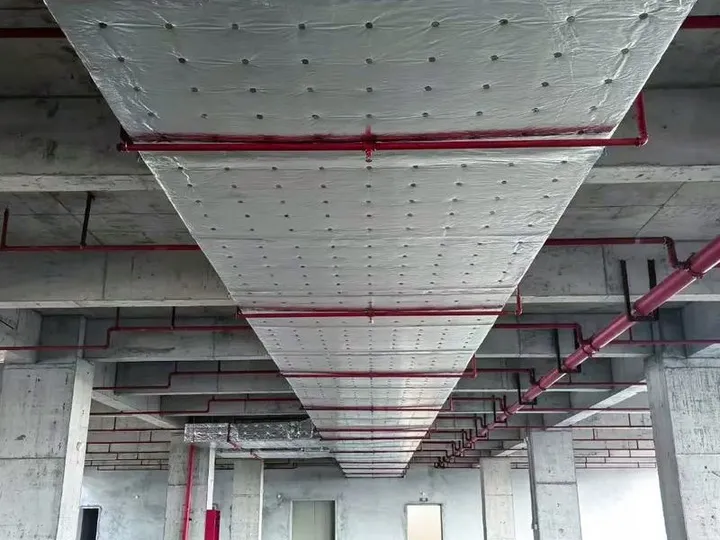
Foil faced duct insulation is used on HVAC ducts for thermal and reflective performance. The facing may serve as a vapor barrier depending on its construction. Buyers should specify the duct substrate, facing laminate, adhesion, fire and smoke requirements, and installation method. A foil facing that works on a rectangular duct may not suit a flexible duct or a different closure method. The duct surface and the facing adhesive both affect long-term performance.
Foil faced duct wrap is a flexible insulation wrap with a foil facing for ducts. It differs from other duct insulation constructions in how it is installed and how the facing behaves at seams. Facing vapor performance, laminate build, and local code requirements should be confirmed. Ding He can review an enquiry with the duct and facing specification, including flexible duct film structures.
Facing Laminates From Ding He
Ding He is Hangzhou Ding He Aluminum Foil And Plastic Products Co., Ltd., established in 2001. The factory covers 3,000–5,000 m² at Yangling Industrial Park, Taihuyuan Town, Lin’an, Zhejiang Province, China, and employs 11–50 people. Ding He runs coating and lamination lines with annual capacity around 10,000 tons, and ships to 20+ countries. The processes include dry lamination, solvent-free lamination, extrusion coating lamination, coating, and slitting on automatic high-speed CNC slitting machines of German origin.
Ding He supplies aluminum foil laminates and plastic films in industrial rolls. A detailed request covering structure, thickness, width, and quantity lets Ding He review the build and prepare samples with a technical data sheet when needed. Production lead time differs by product and order quantity and is confirmed for each order. Ding He accepts inspection by agencies such as BV or SGS, and ships from Shanghai port, Ningbo port, or another port the customer prefers. Payment is by T/T, L/C, D/P, D/A, Western Union, MoneyGram and PayPal.
Request a quotation
Tell us your insulation product and how the facing will be used.
Or write to sales@foillaminates.com